
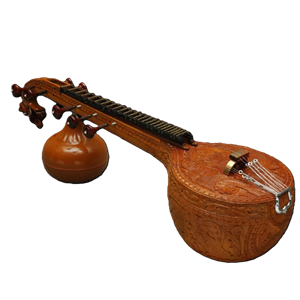
The Veena—particularly the Saraswati Veena—holds a majestic and foundational place in classical music. As a complete instrument that contains both the melody and the rhythm mechanism within itself, learning it offers an incredibly comprehensive musical education and a profound set of personal benefits.
Here are 10 key benefits of learning the Veena:
- Masterful Precision of Swarasthanas (Pitch Positions)
Unlike fretless instruments, the Veena’s 24 fixed brass frets provide a perfect visual and tactile map of the musical scale. This structural clarity allows students to deeply understand the exact positioning of notes (swaras), making it an exceptional tool for anchoring a flawless sense of pitch.
- Deep Understanding of Gamakas (String Deflection)
The Veena is unparalleled in its ability to teach the continuous nature of Indian classical notes. By pulling the heavy strings laterally across the frets, a player learns to glide through microtones and execute complex gamakas from a single fret position, mastering the fluid, ornamental soul of the raga.
- Built-In Rhythmic Synchronization (Tala Laya)
The Veena features secondary drone and rhythm strings (tala strings) played by the right-hand pinky finger. This requires the player to maintain the rhythmic meter simultaneously while the index and middle fingers pluck the main melody strings. It instills an rock-solid, internalized sense of rhythm.
- True Emulation of the Human Voice (Gayaki Ang)
The Veena is historically considered the closest instrumental mirror to the human voice. Because of its sustained resonance and the ability to slide seamlessly between notes on a single stroke, players learn to “sing” through the instrument, replicating the subtle emotional nuances and lyrical beauty of vocal music.
- Advanced Neurological and Multi-Tasking Coordination
Playing the Veena is a masterclass in cognitive processing. The brain must coordinate independent movements across both hands: the left hand pressing and pulling strings horizontally and vertically, the right index and middle fingers alternating plucks, and the right pinky executing independent rhythmic strums.
- Therapeutic and Meditative Acoustic Resonance
The large acoustic resonators (kudam) of the Veena rest directly against the player’s body. The deep, rich, low-frequency vibrations generated by the heavy bronze and steel strings resonate physically with the performer, inducing a profound sense of calm, lowering stress, and acting as a form of sound therapy.
- Superior Finger Strength and Dexterity
The gauge of Veena strings requires deliberate physical pressure and precise plucking techniques. Regular practice significantly builds physical endurance, hand strength, and exceptional tactile dexterity in the fingertips, particularly for the left-hand index and middle fingers.
- Structural and Postural Grounding
Playing the Veena requires a dedicated, grounded physical posture. Seated cross-legged on the floor, with the instrument properly balanced on the lap and thighs, it encourages a naturally upright spine, core engagement, and a disciplined, meditative physical presence.
- A Complete Toolkit for Analytical Musicology
Because it combines melody, harmony (via the drone), and rhythm in one self-contained unit, the Veena is considered the ultimate musicological reference tool. Learning it provides a crystal-clear, comprehensive framework for analyzing ragas, understanding musical physics, and grasping complex compositional structures.
- Immersion in Divine and Classical Heritage
As an instrument with thousands of years of history and deep philosophical roots, learning the Veena connects a student directly to the origins of Indian classical musicology. It fosters a deep-seated appreciation for cultural heritage, artistic lineage, and the timeless legacy of the great Vaggeyakaras (composer-lyricists).