
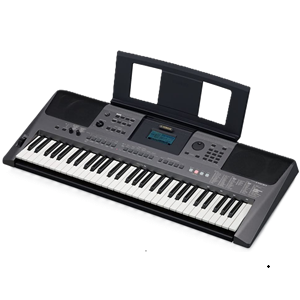
Learning the electronic keyboard or piano provides an exceptionally unique musical foundation. Because it is both a melodic and harmonic instrument that lays out the notes in a clear, linear fashion, its benefits span across music theory, brain development, and modern technology.
Here are 10 key benefits of learning the music keyboard:
- Perfect Visual Map of Music Theory
The layout of the keyboard—with its repeating patterns of white and black keys—presents music theory in a highly visual, linear way. It makes understanding concepts like intervals, scales, semitones, whole tones, and chord structures instantly intuitive compared to almost any other instrument.
- Advanced Multi-Clef Bilateral Coordination
Playing the keyboard requires intense split-brain coordination. The right hand typically plays a fluid melody in the Treble clef, while the left hand provides harmonic support or a bassline in the Bass clef. Reading and executing two different lines of music simultaneously creates robust neural connections between the left and right brain hemispheres.
- Mastery of Polyphony and Harmony
Unlike monophonic instruments (like the voice, violin, or flute) that can only play one note at a time, the keyboard is polyphonic. A student learns to trigger chords, counter-melodies, and basslines simultaneously. This builds a sophisticated, multi-layered understanding of harmony and musical arrangement.
- Gateway to Modern Music Production and Technology
The electronic keyboard is the primary controller for the modern digital music world. Learning the keyboard equips you with the exact finger skills needed to use MIDI controllers, synthesize sounds, program electronic music, and interface directly with Digital Audio Workstations (DAWs) for composing and recording.
- Infinite Sonic and Stylistic Versatility
An electronic keyboard can instantly transform its sound identity at the touch of a button. A student can switch from an acoustic grand piano to a church organ, a string ensemble, a synth pad, or traditional acoustic instruments like the harmonium or veena. This adaptability opens the door to playing any genre of music, from classical to contemporary fusion.
- Enhanced Spatial-Temporal Reasoning
Navigating a keyboard requires translating a visual score into physical space across multiple octaves. Remembering chord shapes, jumping accurately between registers, and judging physical distances without looking at your hands significantly sharpens spatial-temporal reasoning—a cognitive skill closely linked to mathematical ability.
- Instant Pitch Accuracy and Ear Training
Because the keyboard is a fixed-pitch instrument, it produces a perfectly tuned note the moment a key is pressed. For beginners, this eliminates the initial frustration of struggling with basic intonation. Instead, it provides immediate feedback that accelerates interval recognition and absolute ear training.
- Exceptional Finger Independence and Motor Skills
Keyboard techniques demand that all ten fingers act independently with varying degrees of pressure, speed, and articulation (staccato, legato). This rigorous training enhances fine motor skills, hand endurance, and exceptional dexterity in the smaller muscles of the fingers and wrists.
- High-Capacity Working Memory
Because a keyboardist is often responsible for the melody, harmony, and rhythm all at once, memorizing pieces involves tracking multiple musical layers simultaneously. This intensive mental exercise vastly improves working memory capacity, structural retention, and long-term cognitive health.
- Forms a Foundation for All Other Instruments
The keyboard is widely considered the ultimate foundational instrument. The deep understanding of pitch, rhythm, harmony, and notation gained from learning the keyboard gives musicians a massive head start if they choose to transition later to singing, conducting, composing, or learning any string or percussion instrument.